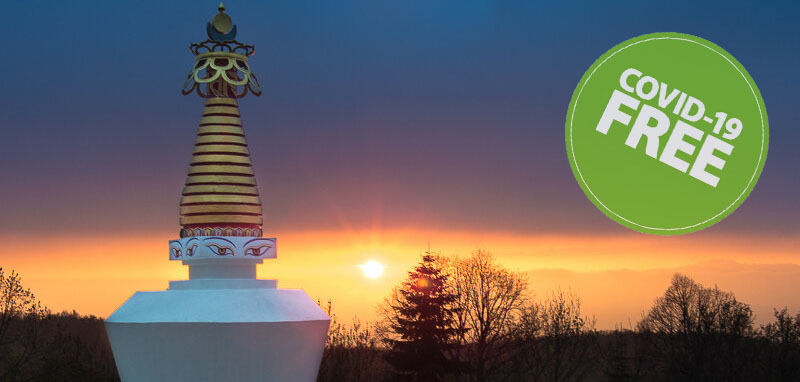
Whether you are vaccinated or not, whether you have a negative PCR test or not, does not change the need to respect sanitary measures.
We are now used to these measures:
Access to the temple will be limited to 70/80 people to respect sanitary distances.
For accommodation, the rooms that accommodate several people will become individual rooms, except for couples or families. The number of places in the dormitory will be reduced to space out the beds. This will allow us to accommodate about 80 people.
The campsite area will be open, and the layout of the tents should follow the same guidelines. Disinfectant will be available in all places where necessary.
These rules must be maintained in Montchardon at all times.
Indeed:
– We have a moral obligation to protect ourselves and others from disease, especially as we live in collective premises.
– It is important to continue to protect Lama Teunsang, whose immunity is greatly diminished, even though he has been vaccinated.
For these reasons, we are asking all those who come this summer to commit to respecting sanitary measures. This commitment will take the official form of a box to be ticked on the registration form, which will allow everyone to come to the Centre with complete peace of mind.
If you cannot or do not wish to follow these guidelines, we ask you not to come to the Centre while these rules are in effect.
The same applies, of course, if you are ill or have symptoms of the virus.
When you leave, if you need to have a PCR test, this can be done in the cities in the area. However, it will be up to you to organise (making an appointment, travelling to and from the test site), because the Centre cannot manage these procedures.
The new sewage system
In the Montchardon adventure, there have been engaging and federating projects such as the construction of a stupa or temple, and others that are less exhilarating but of prime importance for daily life, such as the creation of a new water treatment plant for the Centre.
Because Montchardon is far from the surrounding villages, it is impossible for us to connect to the communal sewage system. In 1988, the public authorities having asked us to establish an autonomous system, we built a 100m3 concrete pit where all waters from Montchardon are gathered and treated before infiltrating naturally into the ground. Located below the campground underneath the 8 stupas, this installation had so far given us complete satisfaction.
Recently, during the building permit process for the new building, the Administration asked us to increase the capacity of our sewage system. A specialized engineering office advised us to bring the installation up to current standards, which are more environmentally compatible. This advice seemed very relevant to us, since we had been aware of the limits of the system for some years. After studying the situation, and taking into account our present and future needs, the expert helped us choose a new installation capable of treating the effluents of a site receiving up to 200 people. The current capacity being about 130 people, this will also ensure our future development needs.
The chosen solution consists of a biological treatment plant, entirely buried so as to be unnoticeable in the environment. Water is treated by a population of bacteria attached to a support. A clever aeration system facilitates the development of aerobic bacteria which degrade the polluting materials contained in waste water. This makes it possible to obtain non-drinkable yet clean water, that can then be discharged into the natural environment by infiltration.
We wanted to replace the old system under the 8 stupas with the new one before the beginning of the summer courses. We called upon our friend Florent Lamberton, an excavation specialist, who has been working at the Centre for many years with great competence. He coordinated this particularly delicate work: first of all, he delivered 6 large concrete tanks, some weighing more than 11 tons, and then placed them precisely in a 3.5m deep excavation the size of a public swimming pool!
On July 5th, 4 vehicles brought the tanks, preceded by a truck crane, necessary to handle them. All were positioned on an access road laid out for the occasion below the construction site. After the crane was deployed, the impressive operation of removing each tank was carried out easily, in a record time, under the watchful eye of Lama Teunsang standing on the top of the terrace of the 8 stupas.
The total cost of this operation is also impressive: €70,000! This may seem quite expensive… yet if this facility lasts as long as the previous one (32 years), it is an essential and very profitable investment for the Centre.
The 100m3 tank that served as an all-water pit was in good condition: we kept it so that once cleaned and restored, it can be used as a water reserve for the fire services, for watering or for various needs.
Our photographer and friend Salva has made a film and photos that you can see on the french version.
General presentation
In order to give you a more precise idea of this project, we present a video animation made from a digital model, which we created to visualize the building as a whole and to detail the different floors. You will find it here:
The ground floor
It will be reserved for the temple of Nyung Ne, which Lama Teunsang is very keen about (
More about Nyung Ne practice
). The main entrance to the building will be through an access hall on the North side, facing the current big temple. This vestibule will serve as a cloakroom for shoes and outdoor clothing, and be equipped with sanitary facilities.
The temple will be 22m long and 9m wide, i.e. 200m2, an area close to that of the big temple. You can see on the video that the ceiling height increase from 3m at the entrance to 4.5m at the back of the room, to allow different statues to be placed in the altar. The main one for the practice of Nyung Ne is Chenrezig with Eleven Faces and a Thousand Arms, which will be transferred from the present Nyung Ne temple in building B. The other key piece of the altar will be the stupa that was recently set up in the big temple, which houses the relic of a skull fragment of the 3rd Karmapa Rangjung Dorje (more about this relic, click here)
The video shows only a glimpse of the altar and the temple, which will be traditionally decorated. Other statues will be installed on the shelves and we plan to include the Kangyur (the complete collection of the Buddha’s words), which a friend of the Centre gave us a few years ago and which is currently in the retreat centre building. The floor will be made of wood, like in the big temple.
For many years, Didier Eudes, an artist friend living in Le Havre, has been engaged in the making of bas-reliefs illustrating the 12 Acts of the Buddha (see opposite), which he offered to Karma Migyur Ling. These are reproductions of bas-reliefs kept in museums or holy places, true masterpieces of ancient India Buddhist art. For more than 10 years, Didier has patiently created these works one by one, first making a clay mould in which a mineral substrate is poured to give the appearance of reconstituted stone. You might have seen one of these bas-reliefs at the entrance to the Centre, near the secretariat, showing the birth of the Buddha. The other sculptures were stored in the yoga room. Lama Teunsang requested that these bas-reliefs be placed on the walls of the new temple.
1st and 2nd floors
They will each consist of 11 individual rooms and a common sanitary block with two showers and two toilets. Each floor will have two staircases at each end, the second being an emergency access.
The 10m2 rooms will be arranged to facilitate the practice of retreat. Each room will be equipped with a toilet area (washbasin), a bed, a large wardrobe, a table, a meditation area and a shelf for the altar and offerings.
Basement – garden level
As the building is built on a mountainside, the rear part is partially buried while the front is at garden level (see video). This floor will therefore be under the Nyung Ne temple.
In the first version of the project, we thought we would leave this level empty, to be developed in the future. In the end, we felt that it would be better to use it right away by adding an additional seven rooms, based on the model of the upper floors, with a common toilet block. One room will be reserved for the boiler room, linked to the heating network coming from the wood-fired boiler room, with a hot water tank and an emergency boiler.
The rear part will be used as a cellar, surrounded by a gallery forming a sanitary space to isolate the building from the natural terrain.
Use of the building
This new construction will make it possible to organize annual Nyung Ne retreats, either in the form of 100 Nyung Ne or for shorter periods, according to the requests of the practitioners. We will also program collective practices, such as retreats to deepen Shine-Lhaktong meditation over one or several months, or the practice of Chöd. Finally, this building will also be very useful to host individual retreats over more or less long periods, in order to deepen the practice.
Financing
Now that we have chosen the companies that commit to a firm quotation, we know the total amount of this project, which amounts to 1.8 million euros.
We have created a page that explains how the project will be financed and how you can support it.
A little reminder for those who are not familiar with this practice: Nyung Ne is linked to the aspect of Chenresig with eleven faces and a thousand arms, personification of love and compassion of all the Buddhas. Traditionally, this practice is held in high esteem by our masters because it is relatively accessible, represents a powerful means of purification and brings very great benefits. Indeed, it brings together all aspects of the Dharma, according to the three Vehicles.
According to the Vehicle of « Individual Liberation » (Hinayana), the practitioner of Nyung Ne commits to the observance of the vows of ethical conduct, the vows of Sojong. Lay people can thus train in ethical conduct over short periods of time. The heart of the practice is anchored in the Great Vehicle (Mahayana), through the development of the spirit of awakening, love, compassion, aspiration to help all beings. Finally, it implements the means of Vajrayana through the use of visualizations, mantra recitations, the development of meditative experience (samadhi). It is an intensive practice that takes place over 48 hours and includes fasting and silence for 24 hours.
Lama Teunsang has always given it immense importance and has adopted it as one of the main practices of Karma Migyur Ling. Organized every year since 1982, it has become a special feature of Montchardon. Lama Teunsang himself has performed it several hundred times and continues to do eight times each year.
In 1988, Lama Teunsang led the first retreat of 100 Nyung Ne for 7 months in a row. This retreat continued annually for thirty years, until 2017, when Lama Teunsang preferred that the practice be scheduled on a more punctual basis, with sessions of 8 Born Nyung three times a year. The retreats of 100 Nyung Ne will resume as soon as five to seven participants can commit to the entire retreat.
Thus, over the years, 35,000 Nyung Ne have been accomplished, involving thousands of people, which is considerable and extremely rare in the world. To ensure the future of the practice, Lama Teunsang has created a Nyung Ne Fund.
This construction of a new Nyung Ne temple is an ancient wish of the Lama to establish the continuation of this regular practice, to implant it in the soil of Montchardon so that it can continue to be accomplished by future generations.
The present Nyung Ne temple, although very endearing, has become too small and is difficult for the public to access.
Petit rappel pour ceux qui ne sont pas familiers avec cette pratique : Nyoung Né est lié à l’aspect de Tchenrézi à onze visages et mille bras, personnification de l’amour et la compassion de tous les Bouddhas. Traditionnellement, cette pratique est tenue en haute estime par nos maîtres, car elle est relativement accessible, représente un moyen puissant de purification et amène de très grands bienfaits. En effet, elle rassemble la totalité des aspects du Dharma, selon les trois Véhicules.
Selon le Véhicule de « Libération individuelle » (Hinayana), le pratiquant de Nyoung Né s’engage à l’observance des vœux de conduite éthique, les vœux de Sodjong. Les laïcs peuvent ainsi s’entraîner à la conduite éthique sur de courtes durées. Le cœur de la pratique est ancré dans le Grand Véhicule (Mahayana), par le développement de l’esprit d’éveil, l’amour, la compassion, l’aspiration à aider tous les êtres. Enfin, elle met en œuvre les moyens du Vajrayana par l’utilisation des visualisations, de récitations de mantras, du développement de l’expérience méditative (samadhi). C’est une pratique intensive qui se déroule sur 48 heures et inclut le jeûne et le silence durant 24 heures.
Lama Teunsang lui a toujours accordé une immense importance et l’a adoptée comme l’une des pratiques principales de Karma Migyur Ling. Organisée chaque année depuis 1982, c’est devenu une spécificité de Montchardon. Lama Teunsang l’a lui-même accomplie plusieurs centaines de fois et continue à en faire huit chaque année.
En 1988, Lama Teunsang a dirigé la première retraite de 100 Nyoung Né, durant 7 mois d’affilée. Cette retraite s’est poursuivie ainsi annuellement durant trente ans, jusqu’en 2017, où Lama Teunsang a préféré que la pratique soit programmée de manière plus ponctuelle, avec des sessions de 8 Nyoung Né trois fois par an. Les retraites de 100 Nyoung Né reprendront dès que cinq à sept participants pourront s’engager pour la retraite entière.
Ainsi, au fil des années, 35 000 Nyoung Né ont été accomplis, auxquels ont participé des milliers de personnes, ce qui est considérable et extrêmement rare au monde. Pour assurer l’avenir de la pratique, Lama Teunsang a créé un Fonds Nyoung Né.
Cette construction d’un nouveau temple de Nyoung Né est un souhait ancien du Lama pour établir la pérennité de cette pratique régulière, l’implanter dans le sol de Montchardon pour qu’elle puisse continuer à être accomplie par les générations futures.
Le temple actuel des Nyoung Né, bien que fort attachant, est devenu trop petit et est d’un accès difficile pour le public.
Since the epidemic is evolving favourably, the French government has authorized the reopening of places of worship, hotels and restaurants. Therefore, we will resume our activities this summer with special operating conditions (see below).
The programme that we partially announced in March will generally be followed.
From June 15th we will reopen to people from the area who wish to attend the daily practices, in the morning, at 5.45pm for Mahakala and 8pm for Chenrezig.
People who will come will have to strictly and constantly respect the protective measures (see here the rules).
We will open reservations for the first 3 weeks of July as of June 20th, and for all July and August courses as of June 25th.
Shiné-Lhaktong – Lama Tsultrim from Sat 04 to 09 July
Lama Teunsang is not able to teach this summer and has asked Lama Tsultrim, who has been living in Montchardon for a year, to lead the three weeks of Shine-Lhaktong, with the usual help of Alain Duhayon during the 2nd and 3rd week.
Méditation dans la vie quotidienne – Lama Deundam from Sat 18 to 23 July
Lama Deundam will develop the bases of a daily practice by addressing the different points of the Buddhist teaching.
4 Seals of Dharma – Lama Sangpo from Sat 25 to 29 July
Lodreu Rabsel Rinpoche is confined to his home in Nepal, where the health situation still seems very bleak, therefore he will not be able to come this summer. We have asked Lama Sangpo to replace him to teach the « 4 Seals of Dharma », a theme which HH the Karmapa Trinley Thaye Dorje has stressed as important in his regular messages about the world health situation. This fundamental teaching defines the Buddhist vision of reality.
Pratique de Qi Gong – Droupla Dorje Gyamsto (Pierre Paret) from Sat 25 to 27 July
The program will also include a new course, led by Pierre Paret, who has just come out of a three-year retreat and will teach Qi Gong for three days at the end of July.
Commentary of the Bodhicaryavatara: Patience – Khenpo Chochok from Sat 01 to 07 August
Khenpo Chochok will teach on the theme of patience, based on the commentary of the Bodhicharyavatara. It is an extremely precise exposition of the paramita (perfection) of patience. When we suggest this theme to him, Khenpo was very enthusiastic saying, « this is really the teaching that people need in these difficult times that we are going through ».
Sangyé Menla, Medicine Buddha – Lama Teundroup from Sat 08 août to 11 August
The annual teaching and practice of Sangye Menla will be given this time by Lama Teundroup, who arrived at our centre last November.
Les quatre placements de l’attention – Trinlay Rinpoché from Sat 15 août to19 August
During the weekend of August 15th, Trinlay Rinpoche will lead a 5-day practice session of the meditations of calm-abiding (shamata) and insight (vipassana) according to the Kagyu tradition, alternating teaching, practice and question and answer sessions.
Chöd retreat – Lama Tsultrim from Sat 22 to 26 August
During these days, Lama Tsultrim will focus on the practice of Chöd Ludjing, the short practice of Chöd. He will give the instructions of this practice which will be performed several times during these days.
Se relier à une divinité de méditation – Droupla Yeshé Tcheudreun (Fabienne Dupuy)
from Sat 22 août to 24 August
Droupla Fabienne will give three days of teaching on how to relate to a meditative deity, focussing as an example on the practice of Chenrezig. This is part of a new cycle of teachings designed to support the practice, which we wish to offer on a regular basis.
Grand rituel de Tcheu – Lamas des différents Centres Kagyu from Friday 28 août to Sunday 30 August
The summer will end with the practice of Tcheu during 3 days of ritual with lamas from different centres.
The programme for autumn courses will be published during the summer.
For visitors to the Centre, Sunday visits will resume at the beginning of August.
We will open reservations for the first 3 weeks of July as of June 20th, and for all July and August courses as of June 25th. Due to covid constraints, it is necessary to limit the number of visits to the reception desk, which implies that instead of paying only the deposit you will have to pay the total amount of the stay upon registration, so that you will not have to pay on arrival.
Booking will therefore be a 3 steps-process:
In the event of a change of stay, price adjustments will be made preferably by e-mail, or by stopping by the reception desk if necessary, during your stay. In case of cancellation, the deposit will be refunded according to the usual conditions, and the rest of the amount will be refunded or credited for a future stay.
We remind you that the participation to the courses is subject to the respect of the rules requested by the Centre that you can read on the page » The organisation of Montchardon this summer « .

Voici comment nous nous organiserons.
Pour les lieux cultuels comme Montchardon, les règles fixées par l’État sont les suivantes :
Si vous ne pouvez ou ne souhaitez pas suivre ces directives, nous vous demandons de ne pas venir au Centre tant que ces règles seront en vigueur. De même évidemment si vous êtes malade ou présentez des symptômes du virus.
Il est essentiel de protéger Lama Teunsang dont l’immunité est compromise, ce qui le rend extrêmement vulnérable aux infections, ainsi que les personnes du centre sont quotidiennement à son contact pour lui apporter ses repas et pour les soins. Cela implique par ailleurs qu’il ne convient pas de rentrer chez Lama Teunsang pour le saluer. Pour les raisons impérieuses citées ci-dessus, il ne reçoit actuellement que ceux qui s’occupent de sa santé.
Pas d’offrande de kata à Lama Teunsang
Il est demandé de se tenir loin de lui, au minimum 1m et de ne pas lui offrir de kata.
Cet usage, tant prisé par nous tous, est actuellement suspendu le temps du Covid, pour préserver sa santé encore fragile.
Entretien individuel avec Lama Teunsang
Nous avons posé la question des entretiens personnels à Lama Teunsang. Il ne souhaite pas les reprendre pour l’instant. Nous vous informerons de leur reprise lorsqu’il nous l’indiquera.
Par contre, il est possible de demander un entretien avec un des Lamas de Montchardon. Voir avec le traducteur.
L’accès au temple sera limité à 80 personnes pour respecter les distances sanitaires. Pour les logements, les chambres à plusieurs deviendront des logements individuels, sauf pour les couples ou familles. Le nombre de places en dortoir sera diminué pour espacer les lits. Nous pourrons ainsi loger environ 80 personnes. Le camping sera ouvert, l’implantation des tentes devra suivre les mêmes consignes. Nous disposerons dans tous les lieux où cela est nécessaires des liquides de désinfection.
Nous vous rappelons :
En tant que pratiquants bouddhistes, les contraintes du masque, des distances sociales et du lavage fréquent des mains peuvent être intégrées à notre pratique, comme entrainement de chaque instant à la vigilance et support d’attention dans nos actions quotidiennes. C’est aussi une formidable opportunité de pratiquer l’esprit d’éveil, l’attitude altruiste : « je m’engage à faire cet effort, en pensant davantage au bien-être et à la santé d’autrui qu’à mon propre désagrément ». Ce sont les moyens habiles du Dharma appelés « l’intégration des désagréments au chemin ».
Vue calendrier / Calendar View