
Lama Teunsang was born in the province of Kham, in eastern Tibet. He went into exile in India starting in 1959, and was eventually invited to come to France, to Montchardon, in 1976.
Jean-Pierre Schnetzler was one of the first Buddhists in France — at least one of the first to take refuge in the Three Jewels on French soil.
Here is their story: the one Lama Teunsang told us in pieces over the years, and the one Jean-Pierre tells himself in a short autobiography.
Biography of Lama Teunsang
His childhood
Lama Teunsang was born in 1934 in a small village called Kierong, in the Kham region, in eastern Tibet.

The village of Kierong
He grew up in a family deeply rooted in the Buddhist tradition, descended for several generations from a line of ngagpas, lay practitioners. His father, a lama at a monastery of the Serkyem Gompa type, was also a yogi engaged in the practice of Chöd, spending long periods in retreat; he was considered a practitioner who had reached a certain level of realization, as was his brother, Lama Teunsang’s uncle, known for showing powers gained through his practice.
Because his father was often away for long periods, young Teunsang’s upbringing was mostly the responsibility of his mother, his older brother, and his uncles and aunts.
Serkyem Gompas are a special type of monastery. Unlike traditional monasteries, reserved only for monks or nuns who have taken monastic vows, they welcome both monks and lay people together: they are both centers for group practice and places for retreat, open to mostly lay practitioners for various spiritual activities.
This detail matters, and we will come back to it later, when we talk about the founding of the Karma Migyur Ling congregation in 1994.
The family lived a life that was both settled and nomadic: they owned livestock, mainly yaks, which they took up to the high plateaus during the summer. This way of life, shaped by the seasons and by travel, was part of the everyday world Lama Teunsang grew up in.
From a very young age, Lama Teunsang stood out for his strong character. One story illustrates this. Around the age of six, while he was watching over the herd, a yak went missing. The child went looking for it, went deep into the forest, and was not seen again for several days. People were very worried: not only because such a young child was alone in the mountains, but also because of the danger from Dremong, the great mountain bears feared for their strength and aggressiveness — comparable to what we would call grizzly bears, known to attack people. All the villagers searched for him, without success. It seemed unlikely that a child this young could survive in such a harsh environment, and the family was about to begin funeral rituals when he reappeared, leading the missing yak on a rope.
Pilgrimages in Tibet
Very early on, around the age of 8, Lama Teunsang began making pilgrimages on foot, together with his older brother, Karma Paljor, who must have been about 6 years older than him.
He started by visiting all the holy places around his home region: the monasteries, caves, and sacred sites, which are very numerous in this region of Kham and Amdo, a neighboring Tibetan province. From time to time, he returned to his family, only to set out again even further, eventually making the great journey to Lhasa and to all the holy places of central Tibet and Tsang. This journey is said to have covered around 1,000 kilometers on foot, crossing high mountain ranges covered in glaciers, walking across the steppes of the Tibetan high plateaus, and fording rivers. The whole journey lasted between 3 and 6 months.
For such a journey, pilgrims traveled very light, carrying only the bare minimum and begging for food along the way. Solidarity was constant: wherever they went, Tibetans, all moved by their faith, showed endless generosity.
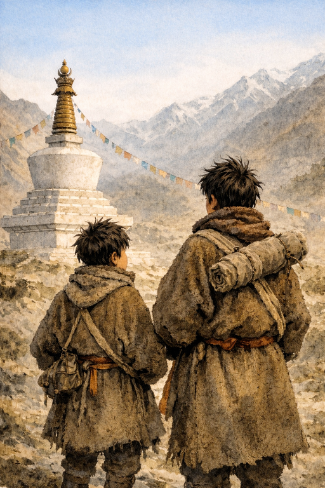
These journeys took Lama Teunsang from Kham to central Tibet, through many holy sites of Tibetan Buddhism. These were not simple trips: at each place, they stayed a few days to make prostrations, walk around the site (circumambulations), pray, and perform rituals. They traveled sometimes alone, sometimes joining other pilgrims or groups of travelers.
Lama Teunsang knew the holy places of central Tibet by heart — their names, their locations, their special features. This close knowledge, gained during these years of pilgrimage, would prove valuable much later: in the 2000s, when he was able to return to Tibet for the first time since his exile (we will come back to this later), he guided us to places that even the local guides did not know about.
That is how we once found ourselves in a small village deep in a valley near the Tsangpo river, where there was a stupa said to contain the eyes of a bodhisattva called Taktu Ngu, « the one who always weeps, » mentioned in Gampopa’s Dhagpo Targyen. Our official guide, who was supposed to show us the region, clearly felt uneasy about leaving the paths approved by the authorities. But he had little choice: Lama Teunsang had cheerfully taken charge of the journey and kept leading us from one surprise to another, clearly delighted to show us places that no one else would have shown us.
First meeting with the Karmapa
This is a passage from an interview with Lama Teunsang recorded in 2009. It is included in Gerd Bausch’s book about the 16th Karmapa, « Radiant Compassion. »
« I was eleven years old when we left our home in Kham for a pilgrimage to Tsurphu, where we wanted to meet Yishin Norbu [a respectful way of referring to the Gyalwa Karmapa, which Lama Teunsang often used]. Our group had ten to fifteen pilgrims, including my father. We traveled all the way to Tsurphu, the Karmapa’s monastery, passing through Lhasa. Once we arrived, we asked for an audience with Yishin Norbu. We were told it was completely impossible to meet him, because he was in a long retreat.
We decided to wait, still hoping we might be able to meet him. After a month, we asked his attendant again, and again we were refused, because the Karmapa was still in retreat. However, we were offered different kinds of blessings using objects he had blessed.
Some of us cried at not being able to meet him after such a long journey. My father then said: « We should simply think that we have seen him! We are here, in this special place, the Karmapa’s residence; we have spent some time at Tsurphu and were even able to visit some rooms of the monastery. Even though we did not meet him, he knows we are here, so we have all his blessings. Instead of leaving now thinking that we did not meet him, let us leave with the conviction that we are filled with his blessing. »
Since we could not stay inside the monastery, we camped outside. The next morning, after waking up and having breakfast, we loaded our bags onto the mules. Once everything was ready, we were about to leave. At that exact moment, a monk called out to us: « There must be pilgrims from Kham here. Where are they? » We answered, « Who is calling us? » « The Karmapa himself. He wishes to see you, » the monk replied. We immediately unloaded the bags and followed the monk to the monastery, where the Karmapa’s attendant was waiting for us. He let us in: « Come, come! How lucky you are! Be quiet and come in! »
The Karmapa stood at the door of his room, majestic, like a statue. We went in and prostrated. He blessed us with his hands; as is customary, we showed our respect to Yishin Norbu by touching his feet. He remained silent. My father expressed our respect for the Karmapa and our great joy at meeting him. But the Karmapa said nothing.
Then the attendant gave each of us a blessing cord, saying: « This is truly incredible. Usually it is not possible to visit him during his retreat, but this morning, he wished to meet the pilgrims. »
That was my first meeting with the Karmapa.
Afterwards, we went back home, full of joy. Several years passed before we saw the Karmapa again. »

The 16th Karmapa in 1954
He spent this whole period, from the age of 8 or 10 to the age of 16, on these pilgrimages, which he chose freely to make. At 16, he returned with his brother to Drepung Monastery, near Lhasa, where they stayed for a year. They then joined the Karmapa’s monastery at Tsurphu, near Lhasa. He would later lose his beloved brother, who died from the bites of a rabid dog.
A Monk at Tsurphu, the Karmapa’s Monastery

Tsurphu Monastery before 1959 (photo enhanced with AI)
Lama Teunsang tells this story: « In 1951, at seventeen, I became a monk at Tsurphu Monastery. Later, the Karmapa gave me all the transmissions I needed, as well as the monk’s vows, initiations, and lungs. At that time, he was in retreat most of the time. We were indeed the Karmapa’s monks, but we rarely saw him, perhaps four or five times a year. From the age of twenty-two (1956) onward, the Karmapa was no longer in retreat as often. He took part in the rituals in the great temple of Tsurphu and gave transmissions, so we saw him more. »
At Tsurphu Monastery, he would live, as he himself used to say, the best years of his life.
Generally, young monks arrive at the monastery very early (around 6 or 7 years old) to study reading and the memorization of texts, as well as the other skills a monk must learn during his training.
Too old for this full course of training, he was at first given only the most modest tasks at the monastery.
He was treated like a laborer at the monastery, given the hardest tasks to do, whether inside the monastery or outside. However, his character, his physical strength, and the practical skills he had developed during his wandering youth quickly caught the attention of the monastery’s authorities, who began giving him tasks suited to his abilities. He became known by the nickname Khamtrug, « the boy from Kham. »
He also proved to be a hard-working and highly motivated student, eager to make up for his gaps in the study of texts. He stayed at Tsurphu until the age of 25, when the massive exile of Tibetans to India took place, in the face of the Chinese invasion in 1959.
1959: Exile to India
Lama Teunsang tells this story: « The preparations for the Karmapa’s flight to India were kept completely secret. So one day in February 1959, shortly after Losar, I was twenty-five years old and was confined to bed with an illness. Suddenly, I was called to the monastery’s office, and one of the officials told me: ‘The Karmapa wants you to go to Bhutan. You leave tomorrow morning.’ ‘Why?’ I asked him. ‘The Karmapa is fleeing to Bhutan!’ was his answer.
I was very surprised, and I had no time to prepare anything. I went to see Drupön Dechen Rinpoche, with whom I was close. I asked him to explain to the Karmapa that I could not go. ‘Don’t say that, no, no! This is the Karmapa’s word — I was there when he spoke about it, and he said that you are the one who must lead the yak caravan to take them to Bhutan,’ Rinpoche told me. ‘But I am sick.’ ‘Even if you are sick, you must go. This is the Karmapa’s word. You cannot refuse,’ he replied.
So I agreed. At five o’clock in the afternoon, the yaks arrived. There were four of us to load the baggage onto about a hundred animals. These were very important items, the monastery’s treasures, which absolutely had to be brought to safety outside Tibet. We worked all night, and by three o’clock in the morning we were ready to leave Tsurphu. We had no time to say goodbye to our families or to do anything else. We had to leave from one day to the next. After the first day of travel, I felt completely healthy again.
We left one day before the Karmapa, because the yaks were not as fast as his group, which traveled on horses with mules, and we finally reached the border of Bhutan, full of relief. The journey lasted about twenty days. »

Arriving at the Bhutanese border, many Tibetans were held there, the local authorities overwhelmed by this flood of refugees. All these people, who had fled the communist threat, were now free, but had no idea what would become of them.
Upon arriving, I handed over the caravan and its precious baggage to officials from Tsurphu Monastery. But I was told that other caravans carrying other treasures from the monastery had been attacked or had gone missing, and that they absolutely had to be found. I agreed to go back, despite the extreme difficulty of this expedition: not only did I have to return to a country invaded by Chinese troops, but I also had to cross the mountain pass that formed the border again, a very high-altitude and very dangerous crossing. My companion refused to come, so I set off alone.
At that time, fighting was taking place between the Chinese and Khampa warriors in this region, and the road went right through the middle of the war zone. The two sides were literally killing each other. Traveling with the yaks was therefore very dangerous. I prayed to the Karmapa without stopping… and I came back safe and sound! In these circumstances, when you are alone with such a caravan, the Chinese mistake you for a Khampa, and the Khampas mistake you for a Chinese sympathizer; so people shoot at you from both sides. But under the Karmapa’s protection, I managed to cross these war-torn territories without any trouble. We could feel the Karmapa’s protection directly. Even though we had almost no chance of surviving, we arrived safe and sound. His protection is so powerful. »
In another interview, Lama Teunsang explained that he went back to Tibet twice more in this way, to recover other precious packages that had been left behind. During one of these journeys, he came across a woman and her two children, who turned out to be relatives of the Karmapa and had become lost. He helped them cross the border. Once settled in India, this family showed great gratitude toward the Lama and gave him a great deal of material support. They were Jampa Gyaltsen and his brother Gelek Tashi.
The Founding and Building of Rumtek Monastery
The Lhasa uprising against the Chinese occupation took place on March 10, 1959. Seeing that the best way to preserve the Dharma was to escape the Chinese grip, the Karmapa chose to flee on March 12, 1959, accompanied by a group of 160 people — lamas, monks, and lay people — heading toward Bhutan. The dangerous and exhausting journey lasted 21 days, and they reached Bhutan on April 2, 1959. As soon as he arrived, he was invited by the Maharaja, the king of Sikkim, which was at that time still an independent kingdom.
This deeply Buddhist king invited the Karmapa to settle in Sikkim and offered him a choice of several sites for the founding of a new monastery.
The Karmapa chose Rumtek, where a small Karma Kagyu monastery already existed, built in the 16th century under the 9th Karmapa, Wangchuk Dorje. This place has all the auspicious qualities needed for the seat of a Karmapa’s activity: seven streams flow there, seven hills face it, a mountain rises behind it, snow-capped ranges stretch out before it, and a river below winds down in a spiral, like the shape of a conch.

The old Rumtek monastery, founded by the 12th Karmapa Changchub Dorje – Peter Mannox
The Karmapa and his entire group arrived at Rumtek at the beginning of July 1959. At that time, the place had only an almost ruined monastery and a few scattered huts in the middle of the jungle. The lack of proper housing and facilities for preparing food made living conditions especially difficult.
The first task, then, was to make the place livable. The land was cleared, tents were set up, and everyone got to work to bring to life the project of establishing a new center for the Karmapa.
At the same time, the Karmapa traveled to Delhi to meet the Indian Prime Minister, Jawaharlal Nehru. Moved by the situation of the Tibetan refugees, Nehru offered his support: the Indian government would help finance the construction and would provide food and clothing.
In 1961, the Maharaja of Sikkim donated about thirty hectares of land at Rumtek, in perpetuity. The Sikkim government also supported the preliminary work and provided building timber.
It was in this context that Lama Teunsang joined Rumtek very soon after his arrival in Bhutan in 1959. Like many other monks who had come from Tsurphu, he had to adapt to basic living conditions. The old monastery, too small to house the whole community, was reserved for the Karmapa and the great masters; the others settled around it, some in tents.

The old Rumtek Monastery – Photo: Alice Kandell

Street behind the old Rumtek Monastery. You can see the huts built to shelter the monks. 1965 – Photo: same
Lama Teunsang, for his part, built a simple hut of bamboo and branches, where he would live for several years.
He took an active part in building the new monastery. But before anything could be built, the ground had to be prepared. The earthworks were done entirely by hand: with crowbars, pickaxes, and shovels.
This site preparation work began on the auspicious date of the twenty-second day of the eleventh month of the Water-Tiger year (1962). Monks and lay people promised the Karmapa that they would finish this part of the work as quickly as possible. About a hundred people, not counting occasional helpers, worked for a year and a half, in all weather, ten hours a day, to clear and level the site.
First, the jungle had to be cleared, then a whole section of the mountainside had to be cut away to create a large platform. The work was long and demanding. And yet, Lama Teunsang describes a surprisingly cheerful atmosphere: people worked hard, but always with lightness and good humor.

Earthworks for the construction of the new temple – Photo: Nik Douglas
One day, while the earthworks were already well advanced and the platform was beginning to take shape, the Karmapa suddenly had word sent to all the workers to leave the site. Everyone obeyed at once. A few moments later, a huge section of the cliff collapsed: a massive landslide buried the entire area that had already been dug out. The fright was immense, but the event also turned out to be providential: a whole part of the mountain that still needed to be excavated had collapsed on its own, greatly speeding up the work. All that was left to do was clear away the earth.
Once the earthworks were finished, construction could truly begin. The first stone of the new monastic center was laid by the monarch of Sikkim on June 16, 1964. The plans for the monastery were drawn by the 16th Karmapa himself, with the help of his secretary Damchö Yongdü. Building the monastery in the purest traditional Tibetan style then took four years.

Construction of the new Rumtek Monastery – Nik Douglas
The whole complex is built around a large central temple. Above it are the floors reserved for the Rinpoches and the great masters, including the Karmapa’s own apartments. Around the main temple is a square courtyard, lined with cells where the monks live. Together, these form a harmonious enclosure: the rooms mark out the space, the temple rises slightly set back, and in front of it opens a large esplanade used for ritual dances.

The new Rumtek Monastery, fully built
One hundred and thirty disciples, including volunteers of various nationalities, worked on its completion. The precious relics, texts, and statues that had been saved from Tibet, along with the entire canon of the Buddha’s teachings in 108 volumes, were placed in the new monastery, and on the first day of the first month of the Fire-Horse year (1966), the Gyalwa Karmapa entered the new center in a grand ceremony; it was a magnificent and highly auspicious event. Rumtek became the official seat of the 16th Karmapa and of the Karma Kagyu lineage.
The whole story of the founding of Rumtek Monastery, and more broadly the story of the 16th Karmapa, is well told in Gerd Bausch’s book « Radiant Compassion. »
Life at Rumtek Monastery
Throughout these years, Lama Teunsang took part in this work. He also describes his daily schedule. He got up very early, around four in the morning. With a friend, he began the day by doing a thousand prostrations. After a quick breakfast, he had to be at the construction site exactly at eight o’clock. Work continued until four in the afternoon. Meals were eaten on site. Whenever a moment was free, he would take out the texts he carried wrapped in a cloth tied around his waist. At every break, he used the time to continue his recitation or study. Around five in the afternoon, they went back to where they lived. But the day was far from over: they still had to go into the forest to cut wood to cook the meal that each person prepared for himself. In the evening, they often did more prostrations, and then, once night had fallen, went to the monastery to receive teachings from their masters.
Lama Teunsang speaks of several of them, in particular Drupön Rinpoche and another master called Tiha Drupön. Both had fled Tibet with the Karmapa and were already elderly, recognized as great masters. Every evening, a group of disciples, including Lama Teunsang, gathered around them to receive explanations and commentaries on the texts.
One evening, when they arrived, they found the lama asleep. Not daring to wake him, they quietly left. The next day, the master welcomed them warmly: « My friends, I did not see you last night. I understand, you must be very tired from the work you do all day. » They replied: « No, we came, but since you were sleeping, we did not dare wake you. » The lama then looked slightly displeased: « No, that is not how it should be. I stay quietly in my room, and I can rest whenever I want. You are the ones who work, so I must fit my schedule to yours. If you find me asleep, wake me up. I am at your service! »
So, evening after evening, they continued to receive these precious instructions. From time to time, the Karmapa himself also gave initiations and transmissions, further nourishing and deepening their practice.
The health situation of the Tibetans was very precarious: poor food, fevers, tuberculosis, and all the other illnesses present in India affected them especially badly. Coming from the high plateaus of Tibet, these refugees had no immunity to these diseases of warmer countries, and many died in the first period after their arrival in India.
Lama Teunsang himself caught a fever that grew so severe that it put him into a coma showing every sign of death. His master was informed, and the funeral practices began. Suddenly, one of the monks cried out: « He just moved! » In the end, he came out of the coma and gradually recovered his health.
Since fleeing Tibet in 1959, Lama Teunsang had had no news of his family. Had they managed to leave Tibet? Were they still alive? He had no idea. It was only a year or two later that he learned they had arrived safely and had taken refuge in northern India, except for his mother, who died during the exodus, and his youngest brother, who drowned while crossing a river in Nepal.
His father, though very elderly, had survived the exodus and was living in a modest house in the region. He lived to a very old age, well past a hundred, and Lama Teunsang had the chance to see him again several times during trips he made with members of Montchardon in the early 1980s.

Lama Teunsang and his father – 1980
His four sisters, their husbands, and their children had gathered around their older brother, Karma Sengue, who led a large community of about a thousand Tibetan refugees in the Sirmour region, in northern India. Moved by deep devotion to the 16th Karmapa, he had set out to lead his whole group to Sikkim, in order to settle near Rumtek, the new seat of the exiled Karmapa. The group was stopped in Delhi, however, and forced to give up this plan, most likely because of the refugee resettlement policy in place at that time.
Three-Year Retreat at Kalu Rinpoche’s Monastery in Sonada
Around 1965–1966, Lama Teunsang learned that a great Kagyu master, Kalu Rinpoche, was going to create a retreat center, a drupkhang, in Sonada, near Darjeeling, in India. In fact, in this place called Sonada, there was a piece of land with a small monastery belonging to Trijang Rinpoche, one of the two tutors of the 14th Dalai Lama. Called to serve the Dalai Lama, Trijang Rinpoche had to leave Sonada in 1966 and placed his monastery under the responsibility of Kalu Rinpoche, who expanded it and equipped it with a three-year retreat center.

View of Sonada Monastery in 1975 – the three-year retreat center in the foreground – Photo: J.P. Schnetzler
Lama Teunsang, drawn by the wish for intensive retreat practice, asked to leave Rumtek in order to undertake this three-year retreat at Sonada. The Karmapa gave him his blessing for this plan, and Lama Teunsang arrived at Sonada. But before entering retreat, the work first had to be done to expand the monastery and build the drupkhang.
The monastery was very poor, and building materials were expensive. The monks therefore collected offcuts of wood from sawmills, called slabwood: these are the outer edges of tree trunks, still rounded, sometimes still covered in bark, removed when the trunk is cut into planks. With these rough pieces, they built the outer walls and the inner partitions.
But these boards, poorly fitted together, left many gaps. To close them, the monks lined the walls with newspaper. Since the building work took place in winter, everything seemed to hold together at first. Then, as soon as the warmer season returned, those who had begun the retreat suddenly heard cracking sounds around them: as the heat caused the wood to shrink, the glued paper tore apart all at once. The walls separating the cells from the outside had to be relined several times.
Conditions were very basic: winters are cold and damp in this region, the cells are tiny, and to do prostrations one had to open the door and stand on the landing. There was no electricity.
The retreat began in 1967. Fourteen monks took part, including Bokar Rinpoche, whom Lama Teunsang came to know and with whom he became close friends, and Lama Gyurme, who has been in charge of the Kagyu Dzong center in Paris since 1975. Kalu Rinpoche was the Drupön, that is, the lama who gives all the initiations, the lungs, and the instructions, and who leads the retreat. Given this master’s experience, learning, and great realization, it was an immense blessing to be able to receive these transmissions from him.

Inside the retreat center. Lama Teunsang is second from the left

The retreatants: Lama Teunsang is in the front row, on the left. Next to him is Lama Gyurme of Paris, in the center Bokar Rinpoche. In the second row, Lama Gelek.
Six months after the retreat began, the retreatants made a discovery as unexpected as it was unsettling: Kalu Rinpoche announced that this retreat would, after all, follow the Shangpa Kagyu tradition. He explained that the Karma Kagyu tradition, which everyone had been expecting, was already widely taught in retreat centers. The Shangpa Kagyu tradition, however, of which he was the holder and responsible for its transmission, had become extremely rare.
Lama Teunsang would go through periods of great physical suffering caused by severe toothaches. In the very first year, a toothache became unbearable and pushed him to a drastic decision: to have the tooth pulled out.
But under retreat conditions, no proper care was possible. So they had to improvise. A young tree, supple and strong enough, was used in the courtyard of the center. His fellow retreatants bent the top branch down and tied a string to it; the other end was attached to the tooth. When the branch was released, the tension was so strong that the tooth was torn out at once. The extraction, however, was incomplete: the tooth broke, and part of the root remained in the gum. Lama Teunsang would go through the rest of his retreat with this fragment, which became infected again and again and caused him intense suffering.
Several times, Kalu Rinpoche offered to let him leave the retreat to get treatment. But leaving the drupkhang meant stopping the retreat, and for Lama Teunsang, that was out of the question.
Toward the end of the retreat, the retreatants made a request to Kalu Rinpoche: to receive the transmission of the Six Yogas of Naropa from the Karma Kagyu lineage. In the Shangpa tradition, it is the Six Yogas of Niguma that are transmitted — instructions that are close in content but presented in a more condensed form.
Kalu Rinpoche replied that it was not customary, within three-year retreats, to give both of these transmissions. However, moved by the seriousness and rigor of their practice and by the results achieved over those three years, he agreed to their request. The retreat was then extended by six months, during which they had to carry out the practice of Dorje Phagmo in abridged form and receive, in condensed form, the Six Yogas of Naropa.
Life at Sonada Monastery
The retreat came to an end in 1970, and Lama Teunsang stayed at Kalu Rinpoche’s monastery to continue serving his retreat master. During the six years before his departure for France, he took part in building Sonada Monastery, named Samdrup Darjay Chöling: the temple, the eight stupas built below the monastery along the road, and various other facilities. He also took care of the education of the young monks placed in his charge.
The first Westerners who visited the monastery describe a very active lama, surrounded by a whole crowd of young novice monks. He took particular care of two young monks: his nephew Migmar, entrusted to him by his sister, who would later go with him to France and become Lama Monlam; and Karma Tashi, who would come to assist him at Montchardon in 1986 after completing his own three-year retreat at Sonada, by then known as Lama Karta, short for Karma Tashi.
Lama Teunsang was away from the monastery several times, sometimes for months at a time, in order to receive transmissions given at Rumtek by the Karmapa or by other eminent masters at various monasteries.
During this period, Lama Teunsang faced serious health problems, including tuberculosis. This disease affected a great many Tibetans at the time, while treatment remained hard to access. His condition became critical, and for a time he was caught between life and death, for lack of effective medication available in the region. In the end, he owed his survival to the generous help of Westerners who were visiting the monastery at that time, who arranged a full course of treatment that allowed him to recover.

Lama Teunsang and Lama Ole Nydahl in the 1970s at Sonada
During this period, he became deeply involved in printing Dharma texts. The Tibetans had fled their country about ten years earlier. Most had been forced to leave in haste, taking only the bare essentials. They now had to rebuild their lives in exile, and the problem of a shortage of texts for study and practice soon became apparent.
In Tibet, texts had traditionally been printed using a woodblock method: the texts were carved onto wooden blocks, onto which a handmade ink was applied, before sheets of handmade paper were pressed onto them to print the texts. Some collections of wooden blocks had been saved from Tibet, or were already present in the Himalayan regions before the exile.
Always very resourceful, Lama Teunsang developed a new inking method based on a mixture made with soot, which did not clog the wooden blocks and produced a very clear print. He became increasingly sought after throughout the region for the quality of his work. This was notably the case with Chatral Rinpoche, a highly respected Nyingmapa yogi who ran a small retreat center near Sonada and was having essential practice texts reprinted. He greatly valued the quality of the lama’s work.
One day, he suggested that Lama Teunsang take part in a new multi-year retreat he was planning to begin soon. Lama Teunsang was pleased by this offer and spoke about it with Kalu Rinpoche to get his opinion, before asking the Karmapa for permission.
Invitation to Come to France
But Kalu Rinpoche told him that he and the 16th Karmapa had an entirely different plan for him: to go to France, in response to an invitation from Jean-Pierre Schnetzler.
Lama Teunsang speaks of this time in these words: « One day, the Karmapa and Kalu Rinpoche told me that I had to go to the West. I had no idea what I would do there. I did not know any Western language, and I had neither planned nor wanted to go. But in our Tibetan tradition, we follow the word of the master to whom we are connected. When they told me, ‘You must go to the West,’ I simply answered, ‘All right.' »
In an interview, Lama Teunsang recalls the conversation he had with Kalu Rinpoche before leaving. « ‘Going to the West will not be of any use,’ he told him frankly. ‘This is the Karmapa’s decision,’ Rinpoche replied. ‘Very well,’ Lama Teunsang agreed. ‘But if I have to go to the West, it would be good if it were somewhere with Tibetans. Since I do not know any Western languages at all, I will be of no use if I find myself alone among Westerners.’ ‘Where you are going, you will not be far from Tibetans,’ Kalu Rinpoche reassured him. ‘It is near Switzerland, and there are many Tibetans in Switzerland!' »
At that time, fifteen lamas were sent to the West together with Lama Teunsang, each one invited to settle in a Dharma center. Before leaving, they went to Rumtek to meet the Karmapa, who gave them several pieces of advice. He explained to them that they were going in order to transmit the Dharma, since at that time the Dharma was still little known in the West. He also asked them not to get involved in politics, and to devote themselves only to teaching the Dharma.
« At that time, some people in the West seemed to want to invite me. That is how I came to Montchardon. »
So much for the lama’s journey. Let us now turn to the man who was to invite him to come to France, Jean-Pierre Schnetzler.
Next: Biography of Jean-Pierre Schnetzler
Next: The Founding of Karma Migyur Ling (1974–1976)
Back to the introduction: Karma Migyur Ling – 50 Years of History
Back to the Karma Migyur Ling homepage
 dans la description du stage